Look inside

Read the First Three Chapters
Title page. Saving Hosanna: Finding a Needle on the Bottom of the Ocean. A True Story. Cathy Crowell. Foreword by Ray Comfort. Wisdom Forge Press.
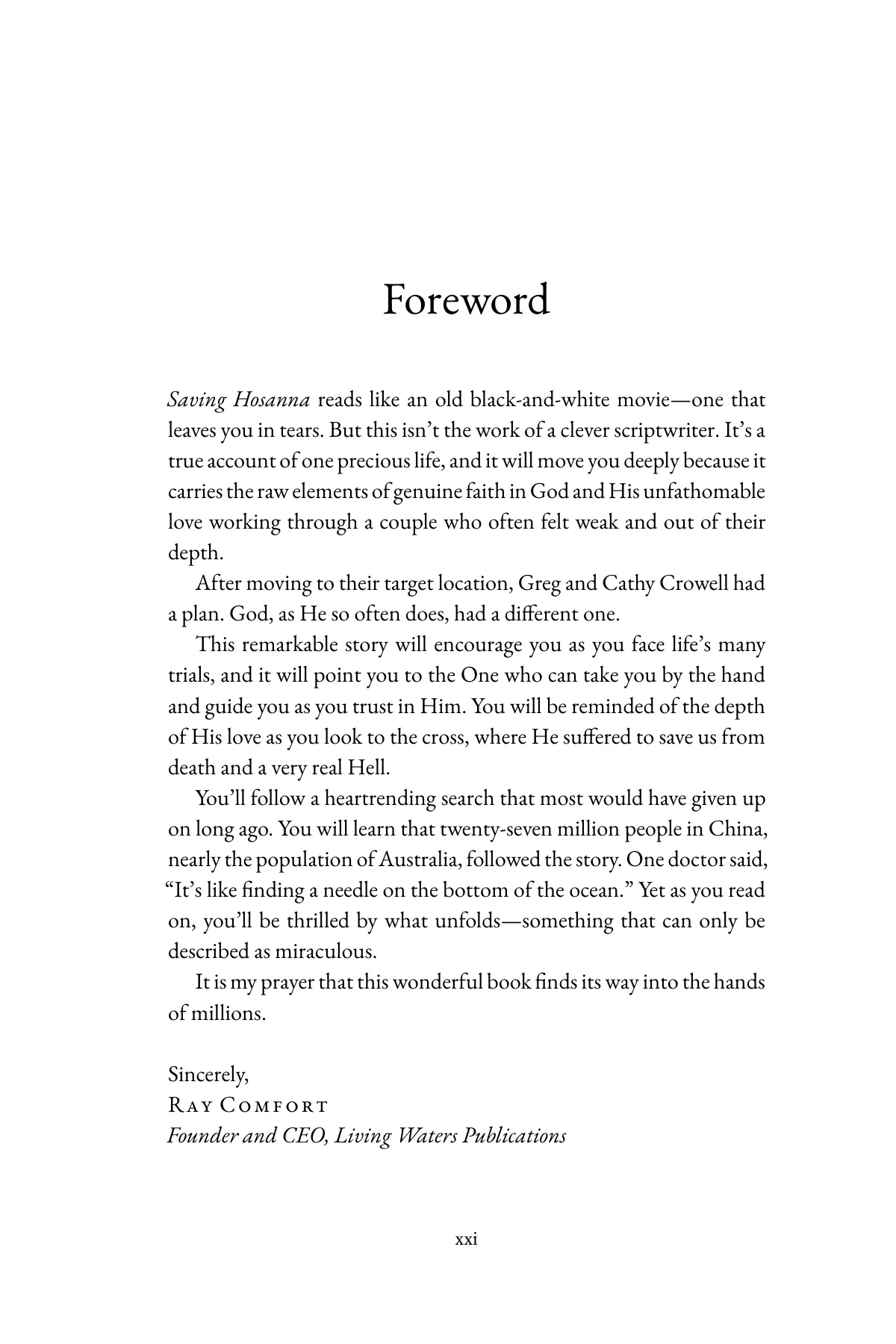
Foreword Saving Hosanna reads like an old black-and-white movie—one that leaves you in tears. But this isn’t the work of a clever scriptwriter. It’s a true account of one precious life, and it will move you deeply because it carries the raw elements of genuine faith in God and His unfathomable love working through a couple who often felt weak and out of their depth. After moving to their target location, Greg and Cathy Crowell had a plan. God, as He so often does, had a different one. This remarkable story will encourage you as you face life’s many trials, and it will point you to the One who can take you by the hand and guide you as you trust in Him. You will be reminded of the depth of His love as you look to the cross, where He suffered to save us from death and a very real Hell. You’ll follow a heartrending search that most would have given up on long ago. You will learn that twenty-seven million people in China, nearly the population of Australia, followed the story. One doctor said, “It’s like finding a needle on the bottom of the ocean.” Yet as you read on, you’ll be thrilled by what unfolds—something that can only be described as miraculous. It is my prayer that this wonderful book finds its way into the hands of millions. Sincerely, Ray Comfort Founder and CEO, Living Waters Publications
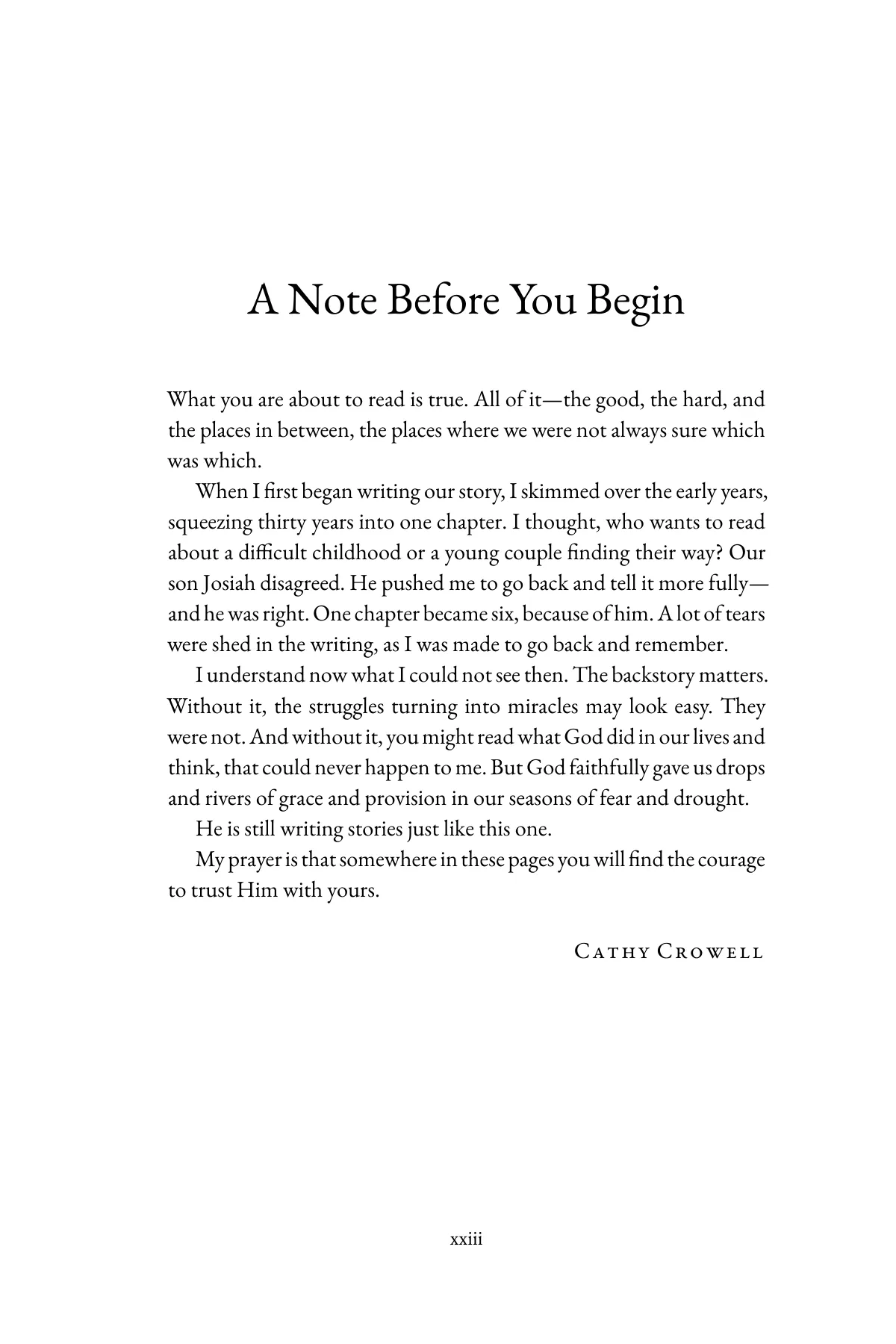
A Note Before You Begin What you are about to read is true. All of it—the good, the hard, and the places in between, the places where we were not always sure which was which. When I first began writing our story, I skimmed over the early years, squeezing thirty years into one chapter. I thought, who wants to read about a difficult childhood or a young couple finding their way? Our son Josiah disagreed. He pushed me to go back and tell it more fully—and he was right. One chapter became six, because of him. A lot of tears were shed in the writing, as I was made to go back and remember. I understand now what I could not see then. The backstory matters. Without it, the struggles turning into miracles may look easy. They were not. And without it, you might read what God did in our lives and think, that could never happen to me. But God faithfully gave us drops and rivers of grace and provision in our seasons of fear and drought. He is still writing stories just like this one. My prayer is that somewhere in these pages you will find the courage to trust Him with yours. Cathy Crowell
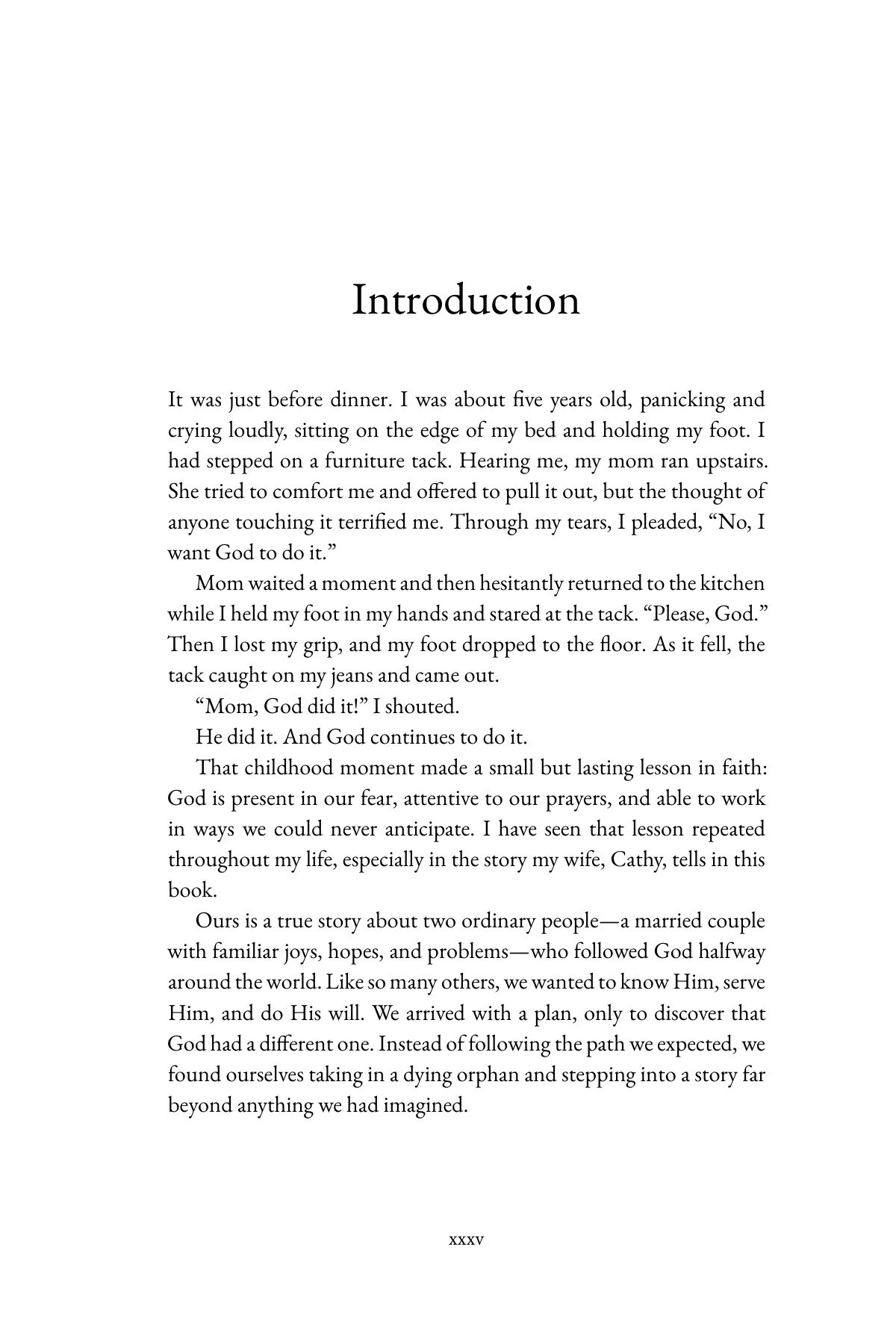
Introduction It was just before dinner. I was about five years old, panicking and crying loudly, sitting on the edge of my bed and holding my foot. I had stepped on a furniture tack. Hearing me, my mom ran upstairs. She tried to comfort me and offered to pull it out, but the thought of anyone touching it terrified me. Through my tears, I pleaded, “No, I want God to do it.” Mom waited a moment and then hesitantly returned to the kitchen while I held my foot in my hands and stared at the tack. “Please, God.” Then I lost my grip, and my foot dropped to the floor. As it fell, the tack caught on my jeans and came out. “Mom, God did it!” I shouted. He did it. And God continues to do it. That childhood moment made a small but lasting lesson in faith: God is present in our fear, attentive to our prayers, and able to work in ways we could never anticipate. I have seen that lesson repeated throughout my life, especially in the story my wife, Cathy, tells in this book. Ours is a true story about two ordinary people—a married couple with familiar joys, hopes, and problems—who followed God halfway around the world. Like so many others, we wanted to know Him, serve Him, and do His will. We arrived with a plan, only to discover that God had a different one. Instead of following the path we expected, we found ourselves taking in a dying orphan and stepping into a story far beyond anything we had imagined.
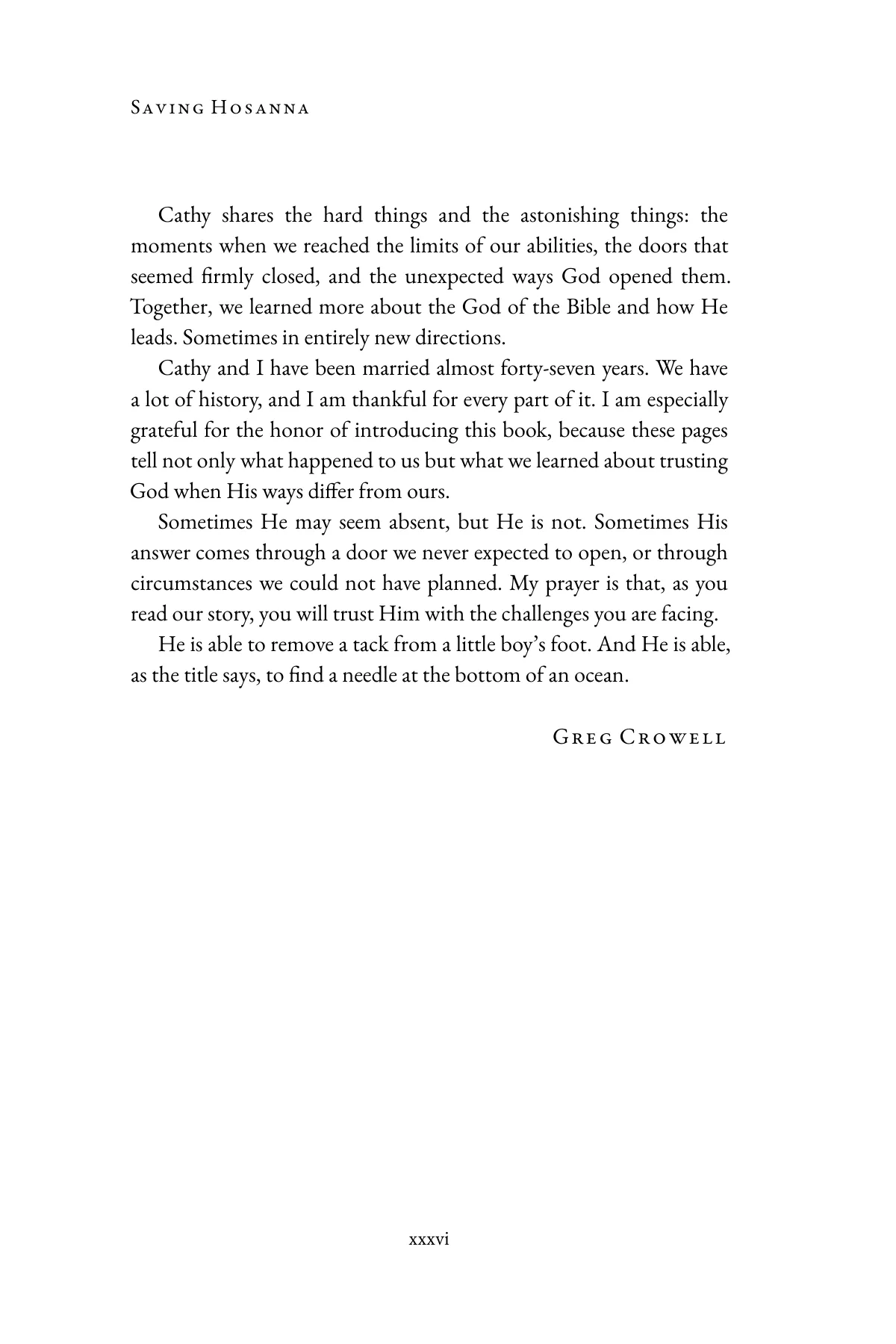
Cathy shares the hard things and the astonishing things: the moments when we reached the limits of our abilities, the doors that seemed firmly closed, and the unexpected ways God opened them. Together, we learned more about the God of the Bible and how He leads. Sometimes in entirely new directions. Cathy and I have been married almost forty-seven years. We have a lot of history, and I am thankful for every part of it. I am especially grateful for the honor of introducing this book, because these pages tell not only what happened to us but what we learned about trusting God when His ways differ from ours. Sometimes He may seem absent, but He is not. Sometimes His answer comes through a door we never expected to open, or through circumstances we could not have planned. My prayer is that, as you read our story, you will trust Him with the challenges you are facing. He is able to remove a tack from a little boy’s foot. And He is able, as the title says, to find a needle at the bottom of an ocean. Greg Crowell
PART ONE The Road to China Circumstances may appear to wreck our lives and God’s plans, but God is not helpless among the ruins. Eric Liddell
CHAPTER ONE Alone My house in Toronto was on my favorite kind of street—both sides lined with large trees that met in the middle every summer. The front had a wood veranda with a roof, framed by two thick, square posts. I climbed up three steps, walked to the door, and wished we still used a skeleton key, the kind used in fairy tales. As a little girl, I badly wanted to live in a happily ever after story. Tucked inside my jacket was just a plain, boring, brass key, always on a string around my neck. I would unlock the door by leaning forward. It was old, dark oak and heavy, and as the door swung open, it groaned, giving me a tired hello. At this time of day, our house was quiet—the particular kind of quiet that only settles over an empty house in the late afternoon. I loved the wood floors and still remember how my footsteps pulled squeaks from the old hardwood. In the stillness, however, one friend was there to greet me: my pet budgie Julie, bright as a daffodil with touches of green along her wings. She would chirp once or twice, sharp little notes,
as if reprimanding me for being away. Both of my parents worked, and my brother Reg, who was seven years older, had a life of his own. It was often just me and my bird at home. I didn’t mind. I loved that house the way you love something that feels more yours when no one else is in it. We had moved a lot when I was small—every year or so, rent unpaid, money spent elsewhere, starting over again. A different house, a different school, a different neighborhood, and the quiet hope that maybe life would be different too. We had settled into this house just before I turned seven, and it was the longest we had stayed anywhere. The house had character. Built in 1909—young for Europe, but considered old in Canada—it wore its age well. Rich wood panelling, darkened over time to a shiny molasses, worn floors full of personality. The staircase met you when you walked in, presenting a curved banister that begged a hand to slide down it. The kitchen and dining room made me smile just thinking about them. Everything was mint green. Mom had painted the walls, and even the old fridge with its rounded corners and dinged-up door had been painted green to match. The only thing in the room that wasn’t green was the fridge handle. Unlike most of the other rooms in our house, this one felt bright—the dark wood trim, instead of dulling it, only made the mint green glow more. The tallest glass in the cupboard was always my target. Two careful teaspoons of sugar went in. Sometimes a third snuck in. Then came the cold milk from the green fridge, poured and stirred slowly until the glass was full to the brim. To me, an instant milkshake. Upstairs, my bedroom was a world my mom had stitched together herself—curtains and a matching bedspread in soft pink flowers, finished with a ruffled skirt that brushed the floor. She could take one look at something in the Sears catalogue and make it real, which felt like magic to a little girl who loved fashion. My window faced the backyard, and at night, with the door closed and the house settling around me,
I could catch the low murmur of my parents’ voices drifting up. They argued a lot. I loved them. But life felt complicated. Dad drank too much. Addiction cuts into a family and leaves a long trail of brokenness. I learned early how to read the sound of the front door opening—I could often tell whether the evening would be quiet or something else. My dad was also a man who could light up a room. A sheet metal worker who built airplanes, he loved his union the way other people loved their faith. Mom said I was more like him—wanting to talk and have emotional connection, even if it meant standing in the middle of one of their arguments. I think he liked me, the little girl who was extroverted like him, and somehow, even in the hard years, I felt that. Mom was independent, capable, and had embraced feminism in ways that shaped her. Affection from her came in quieter forms—a hemmed dress, a bedspread made from scratch, a catalogue dream made real by her hands. One Mother’s Day, I proudly presented her with a bouquet of pink and white plastic flowers I had paid fifty cents for. I was excited as I imagined a special day together. But Mom announced she wanted to be left alone to work in the yard. She seemed angry and sad all mixed together. I was confused. Why would she not want to celebrate and have fun, especially with her kids? After all, we had made her a “mom.” I would come to learn that for some, motherhood felt like a demotion, even a bother. This left an impression on me, and I hoped that if ever I had children, they would feel and know in tangible ways they were more precious to me than anything. It felt like Reg and her had a connection. Maybe it was because they were both introverts, content in their own quiet space, while I was the opposite, a chatterbox, and wanted to be where the action was. Still, her gestures of kindness helped me to know my mom loved me.
Sometime during that first year in the 1909 house, Mom and I walked past a pet store. There in the front window, standing and barking up against the glass, was a little brown dog with a white fluffy chest. Jumping hysterically, practically yelling “Pick me! Pick me!” I wanted her instantly. Mom, said yes, and paid the seven dollars and I carried her home. We called her Trixie, and she got to sleep in my room. Later she had five puppies, and when we had to give them away, I cried, wanting to keep every single one. Around age eight, I was taking subways on my own around the city. I knew the route. Being tiny enough to slip under the metal turnstile meant a free ride. I had learned where the cameras were. Usually making the trip with another “small” friend, we would head to the Toronto Museum or the Science Centre. I felt proud of my independence but aware, somewhere underneath the surface, wondering if anyone had noticed I had gone. All our relatives lived far away from us, in Alberta. Looking back, I think Reg and I would have benefited from having grandparents, aunties, uncles, and cousins nearby. School was a struggle. Getting homework done felt impossible. Boundaries in our home were missing. Often my parents were gone. After school, I filled the hours in front of the TV, watching families that laughed together over dinner and gave hugs at bedtime. They solved any problem in thirty minutes. I badly wanted their life. One evening I asked my parents to please remember to tell me to brush my teeth before bed. I had seen parents on TV shows helping their children with homework and giving instructions like, get ready for bed, brush your teeth, clean your room. I desperately wanted someone to lead me. The intensity in our home and the lack of family life and structure affected me, and it showed up in small, private ways. I had begun wetting the bed and crying almost daily. I also believed a lie—I thought if I could just be perfect, everything would get better.
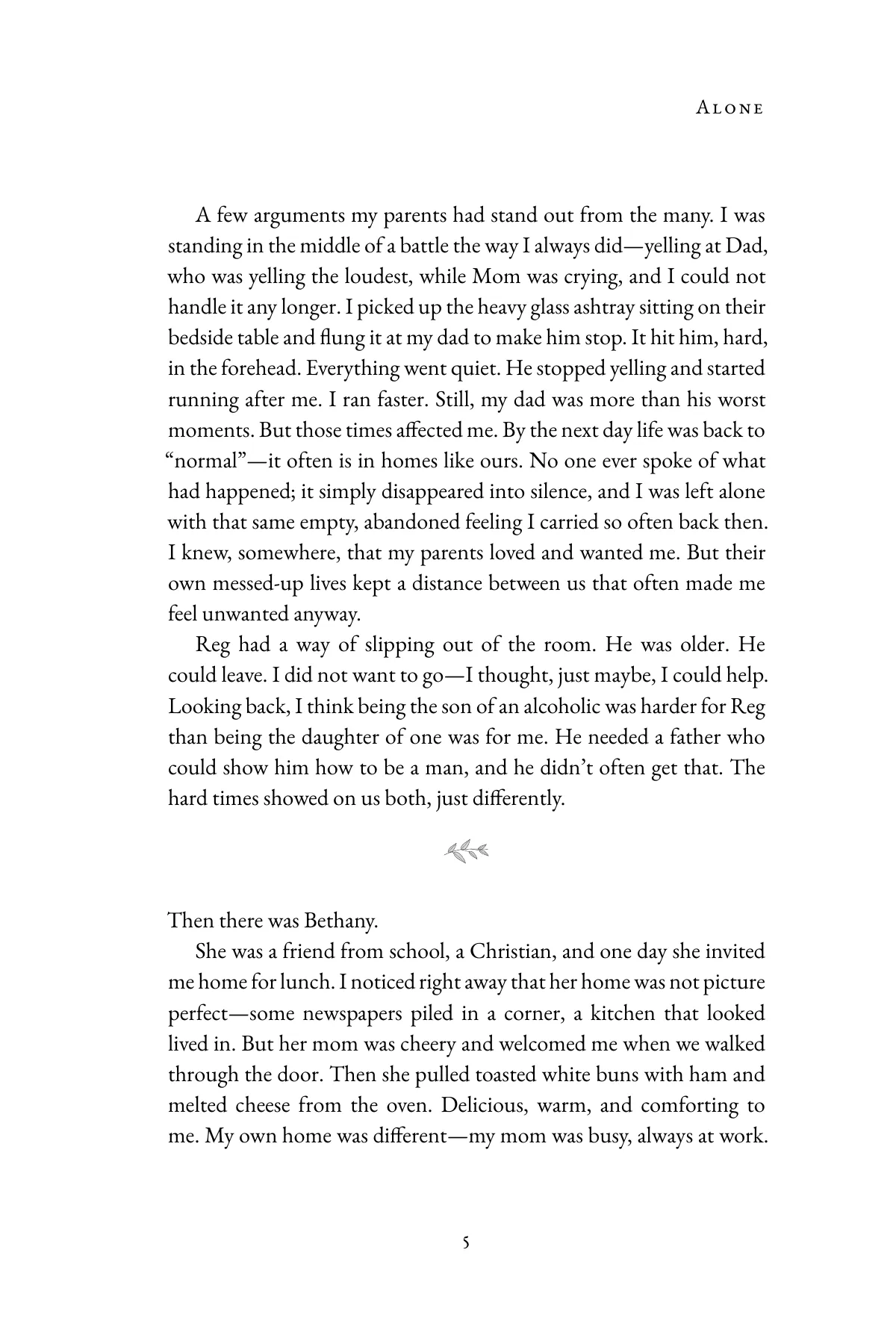
A few arguments my parents had stand out from the many. I was standing in the middle of a battle the way I always did—yelling at Dad, who was yelling the loudest, while Mom was crying, and I could not handle it any longer. I picked up the heavy glass ashtray sitting on their bedside table and flung it at my dad to make him stop. It hit him, hard, in the forehead. Everything went quiet. He stopped yelling and started running after me. I ran faster. Still, my dad was more than his worst moments. But those times affected me. By the next day life was back to “normal”—it often is in homes like ours. No one ever spoke of what had happened; it simply disappeared into silence, and I was left alone with that same empty, abandoned feeling I carried so often back then. I knew, somewhere, that my parents loved and wanted me. But their own messed-up lives kept a distance between us that often made me feel unwanted anyway. Reg had a way of slipping out of the room. He was older. He could leave. I did not want to go—I thought, just maybe, I could help. Looking back, I think being the son of an alcoholic was harder for Reg than being the daughter of one was for me. He needed a father who could show him how to be a man, and he didn’t often get that. The hard times showed on us both, just differently. Then there was Bethany. She was a friend from school, a Christian, and one day she invited me home for lunch. I noticed right away that her home was not picture perfect—some newspapers piled in a corner, a kitchen that looked lived in. But her mom was cheery and welcomed me when we walked through the door. Then she pulled toasted white buns with ham and melted cheese from the oven. Delicious, warm, and comforting to me. My own home was different—my mom was busy, always at work.
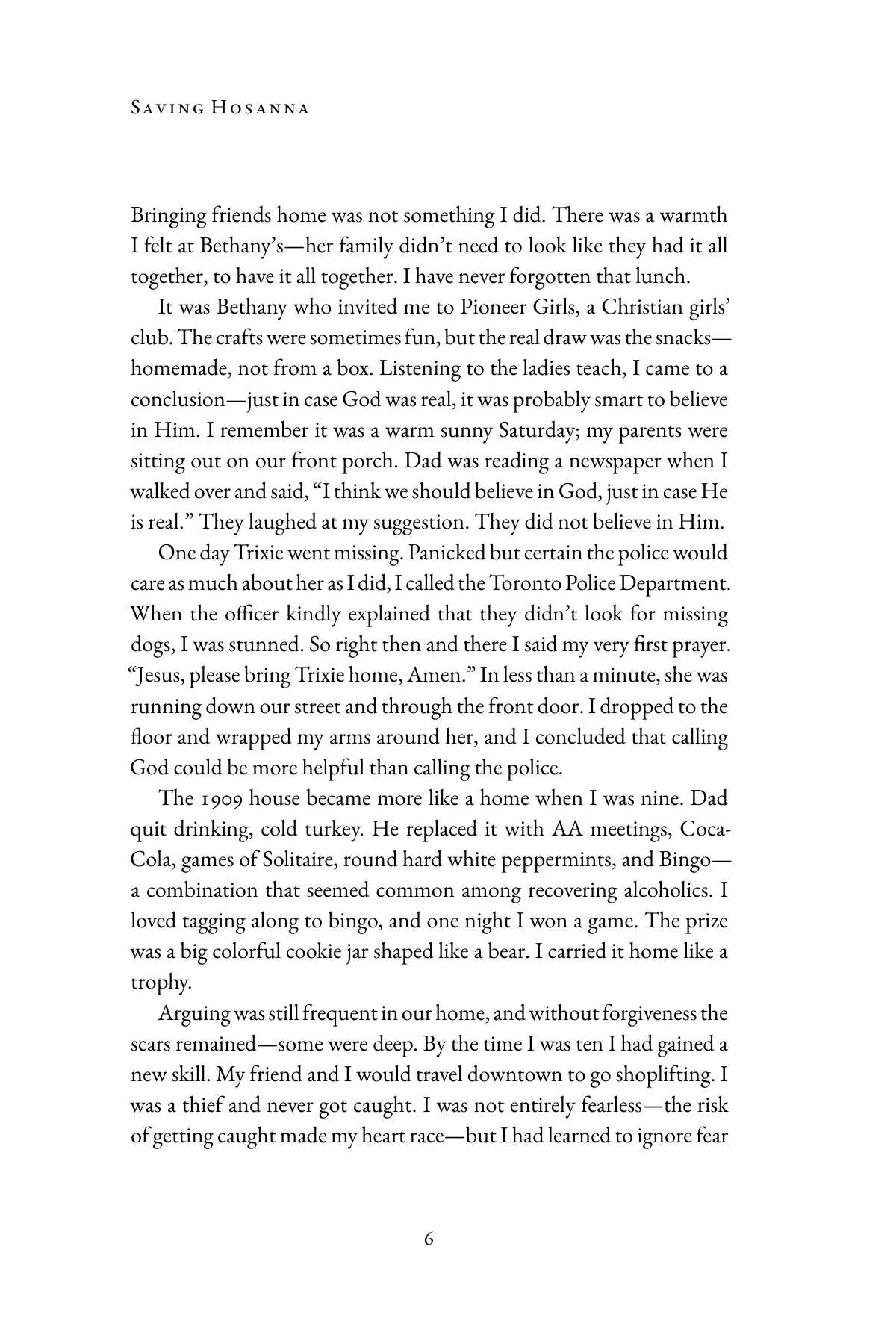
Bringing friends home was not something I did. There was a warmth I felt at Bethany’s—her family didn’t need to look like they had it all together, to have it all together. I have never forgotten that lunch. It was Bethany who invited me to Pioneer Girls, a Christian girls’ club. The crafts were sometimes fun, but the real draw was the snacks—homemade, not from a box. Listening to the ladies teach, I came to a conclusion—just in case God was real, it was probably smart to believe in Him. I remember it was a warm sunny Saturday; my parents were sitting out on our front porch. Dad was reading a newspaper when I walked over and said, “I think we should believe in God, just in case He is real.” They laughed at my suggestion. They did not believe in Him. One day Trixie went missing. Panicked but certain the police would care as much about her as I did, I called the Toronto Police Department. When the officer kindly explained that they didn’t look for missing dogs, I was stunned. So right then and there I said my very first prayer. “Jesus, please bring Trixie home, Amen.” In less than a minute, she was running down our street and through the front door. I dropped to the floor and wrapped my arms around her, and I concluded that calling God could be more helpful than calling the police. The 1909 house became more like a home when I was nine. Dad quit drinking, cold turkey. He replaced it with AA meetings, Coca-Cola, games of Solitaire, round hard white peppermints, and Bingo—a combination that seemed common among recovering alcoholics. I loved tagging along to bingo, and one night I won a game. The prize was a big colorful cookie jar shaped like a bear. I carried it home like a trophy. Arguing was still frequent in our home, and without forgiveness the scars remained—some were deep. By the time I was ten I had gained a new skill. My friend and I would travel downtown to go shoplifting. I was a thief and never got caught. I was not entirely fearless—the risk of getting caught made my heart race—but I had learned to ignore fear
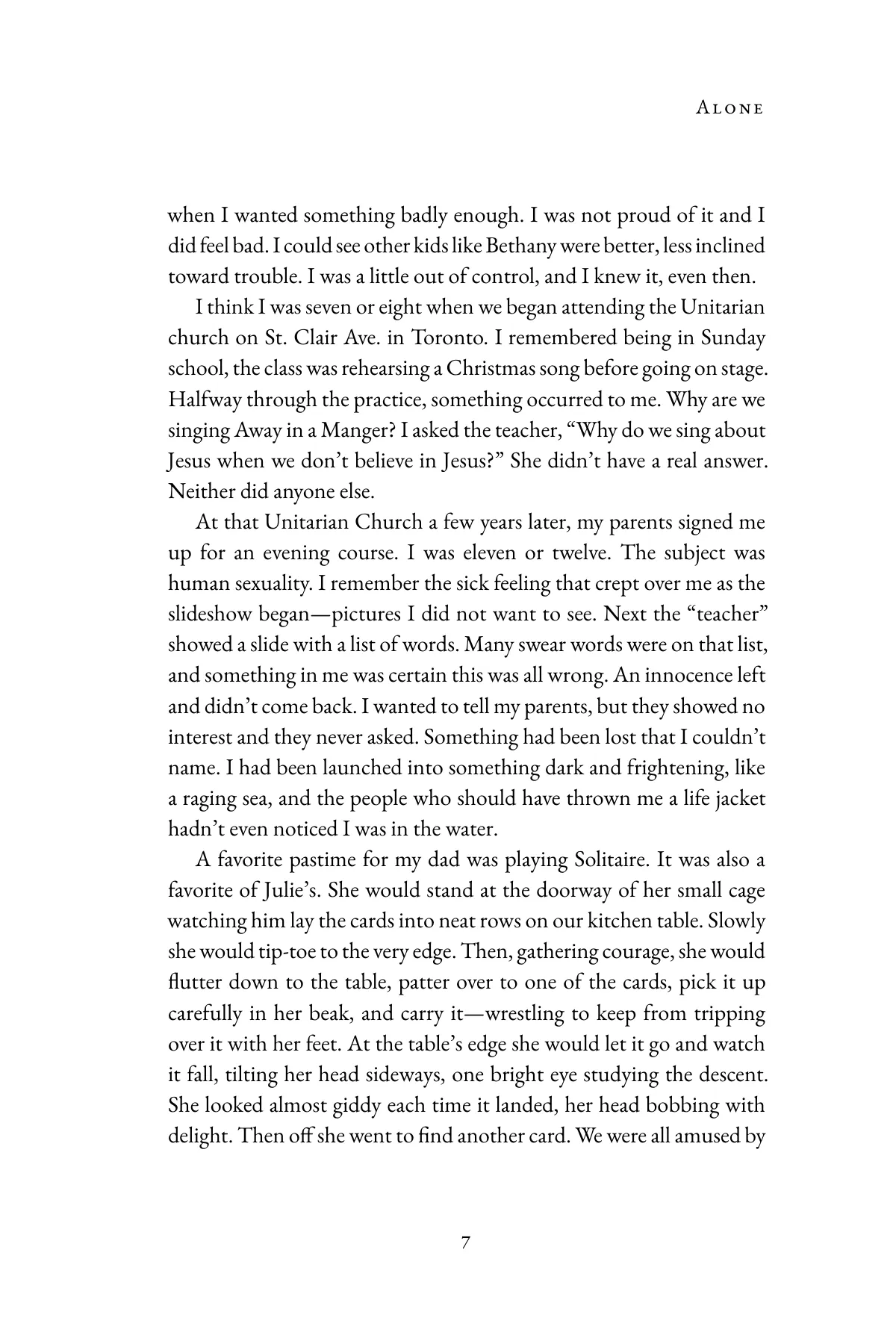
when I wanted something badly enough. I was not proud of it and I did feel bad. I could see other kids like Bethany were better, less inclined toward trouble. I was a little out of control, and I knew it, even then. I think I was seven or eight when we began attending the Unitarian church on St. Clair Ave. in Toronto. I remembered being in Sunday school, the class was rehearsing a Christmas song before going on stage. Halfway through the practice, something occurred to me. Why are we singing Away in a Manger? I asked the teacher, “Why do we sing about Jesus when we don’t believe in Jesus?” She didn’t have a real answer. Neither did anyone else. At that Unitarian Church a few years later, my parents signed me up for an evening course. I was eleven or twelve. The subject was human sexuality. I remember the sick feeling that crept over me as the slideshow began—pictures I did not want to see. Next the “teacher” showed a slide with a list of words. Many swear words were on that list, and something in me was certain this was all wrong. An innocence left and didn’t come back. I wanted to tell my parents, but they showed no interest and they never asked. Something had been lost that I couldn’t name. I had been launched into something dark and frightening, like a raging sea, and the people who should have thrown me a life jacket hadn’t even noticed I was in the water. A favorite pastime for my dad was playing Solitaire. It was also a favorite of Julie’s. She would stand at the doorway of her small cage watching him lay the cards into neat rows on our kitchen table. Slowly she would tip-toe to the very edge. Then, gathering courage, she would flutter down to the table, patter over to one of the cards, pick it up carefully in her beak, and carry it—wrestling to keep from tripping over it with her feet. At the table’s edge she would let it go and watch it fall, tilting her head sideways, one bright eye studying the descent. She looked almost giddy each time it landed, her head bobbing with delight. Then off she went to find another card. We were all amused by
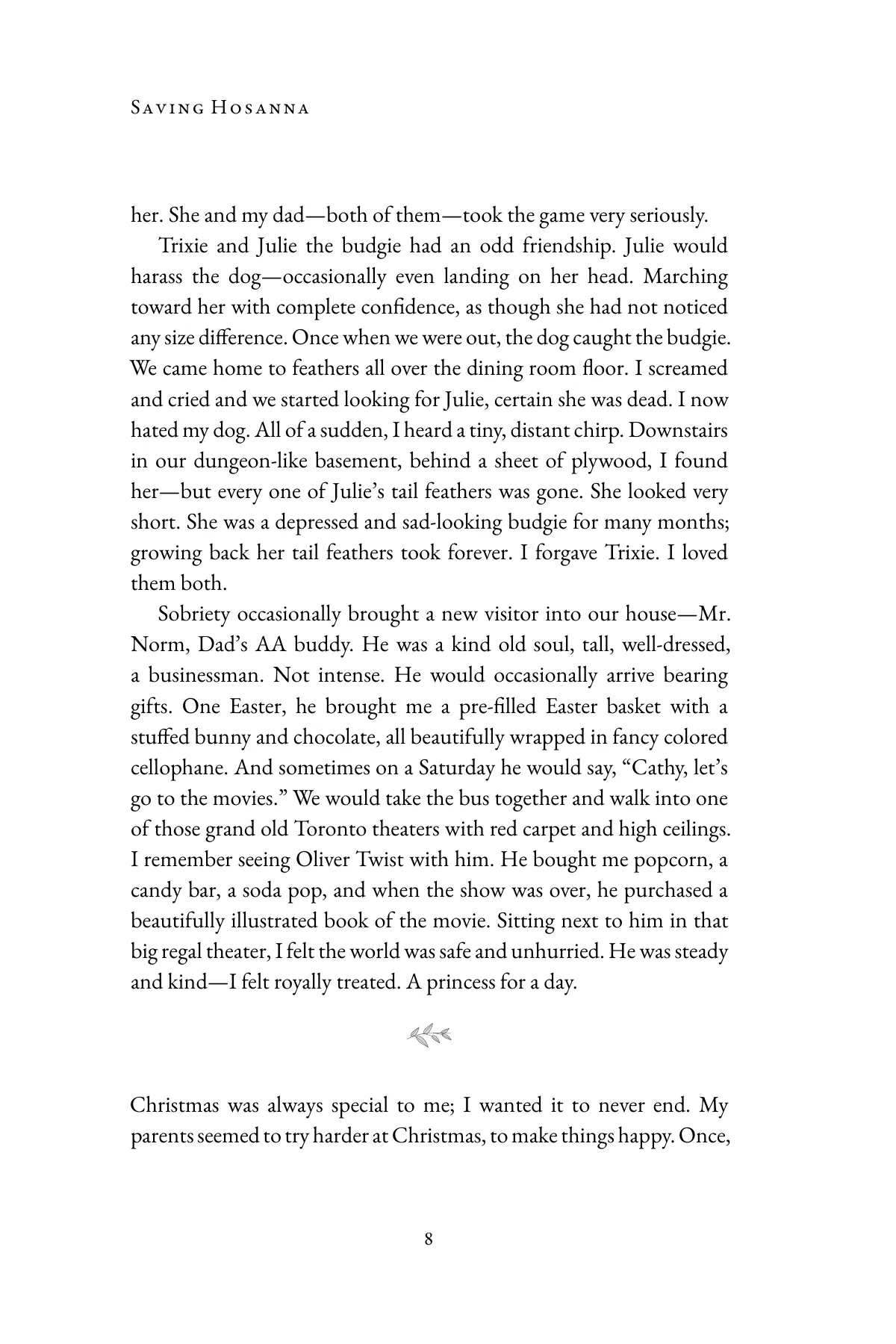
her. She and my dad—both of them—took the game very seriously. Trixie and Julie the budgie had an odd friendship. Julie would harass the dog—occasionally even landing on her head. Marching toward her with complete confidence, as though she had not noticed any size difference. Once when we were out, the dog caught the budgie. We came home to feathers all over the dining room floor. I screamed and cried and we started looking for Julie, certain she was dead. I now hated my dog. All of a sudden, I heard a tiny, distant chirp. Downstairs in our dungeon-like basement, behind a sheet of plywood, I found her—but every one of Julie’s tail feathers was gone. She looked very short. She was a depressed and sad-looking budgie for many months; growing back her tail feathers took forever. I forgave Trixie. I loved them both. Sobriety occasionally brought a new visitor into our house—Mr. Norm, Dad’s AA buddy. He was a kind old soul, tall, well-dressed, a businessman. Not intense. He would occasionally arrive bearing gifts. One Easter, he brought me a pre-filled Easter basket with a stuffed bunny and chocolate, all beautifully wrapped in fancy colored cellophane. And sometimes on a Saturday he would say, “Cathy, let’s go to the movies.” We would take the bus together and walk into one of those grand old Toronto theaters with red carpet and high ceilings. I remember seeing Oliver Twist with him. He bought me popcorn, a candy bar, a soda pop, and when the show was over, he purchased a beautifully illustrated book of the movie. Sitting next to him in that big regal theater, I felt the world was safe and unhurried. He was steady and kind—I felt royally treated. A princess for a day. Christmas was always special to me; I wanted it to never end. My parents seemed to try harder at Christmas, to make things happy. Once,
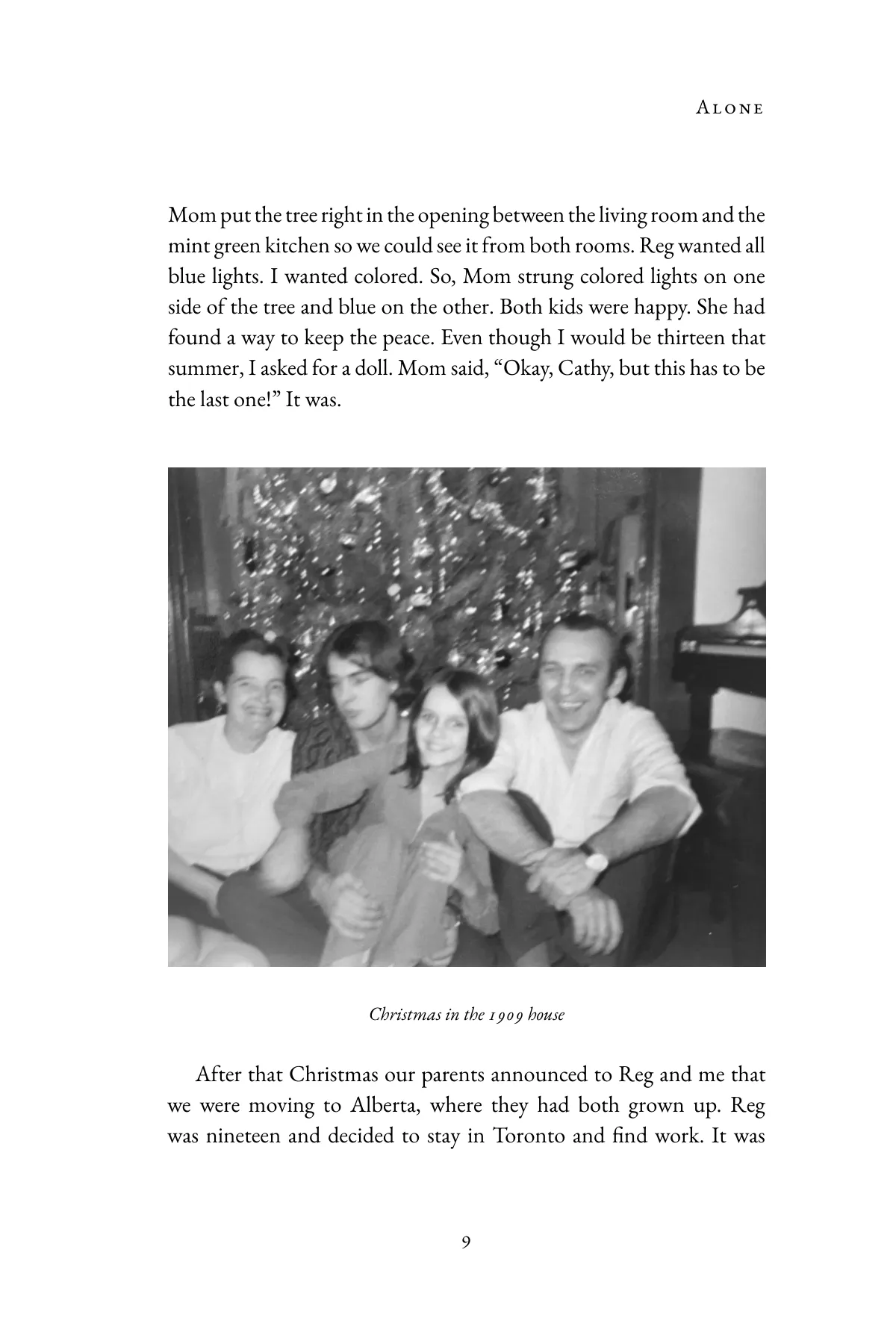
Mom put the tree right in the opening between the living room and the mint green kitchen so we could see it from both rooms. Reg wanted all blue lights. I wanted colored. So, Mom strung colored lights on one side of the tree and blue on the other. Both kids were happy. She had found a way to keep the peace. Even though I would be thirteen that summer, I asked for a doll. Mom said, “Okay, Cathy, but this has to be the last one!” It was. After that Christmas our parents announced to Reg and me that we were moving to Alberta, where they had both grown up. Reg was nineteen and decided to stay in Toronto and find work. It was [Photograph on this page, captioned: Christmas in the 1909 house.]
frightening for me—my brother, my home, and my city were all being left behind. I did not want to leave and felt dragged across the country. I had visited Alberta before. Wide spaces, farms everywhere, no friends and relatives I hardly knew. It was nothing like Toronto. It was going to be a life in the boonies. The dread settled in immediately and did not lift. One month before we left, we moved into a budget motel—a small single room, dark and dingy, with a sketchy bathroom. The five of us squeezed in: Mom, Dad, Trixie, Julie, and me. Mom cooked suppers on a single burner stove. I slept on a fold-away cot near the door. Every day, I traveled over an hour each way to school, taking two city buses. The days felt endless and lonely. It was the longest month of my life. I missed the 1909 house.
CHAPTER TWO The Hound from Heaven Sitting in the back seat, I tried to make the best of it. The old Ford was big and comfortable. I settled in for the 3,454 kilometers journey with my dog and my budgie Julie, who was stuck living and riding in a small hamster cage. Having a stack of comic books helped keep me busy. Somewhere on a lonely stretch of highway in Northern Ontario, the car broke down, and we were stranded for a whole week, waiting for a part. Arriving in Alberta, we moved into a basement apartment where dogs were not allowed. Trixie became our secret—we worked hard to teach her not to bark, smuggling her in and out as quietly as we could. The landlord eventually figured it out and kindly turned a blind eye. In Toronto, I had been ready and excited in my mind for high school—grade nine, finally, the big step up. However, I was shocked to learn, in Alberta, grade nine was the last year of junior high. This news landed like a demotion. I was unhappy, and angry starting school in
Stony Plain, a backward prairie town, as I saw it then. My classmates seemed kind enough—kinder, perhaps, than Toronto kids had been. I had distant cousins in this town, but I had never known them, having lived in Toronto all my life. Baba and Dido’s house (Ukrainian for grandma and grandpa) was one of our first stops after arriving in Alberta. They lived about forty-five minutes away in Edmonton. My dad’s family was Ukrainian, and warmly welcoming in the way that some families simply are—not because life had been easy for them, but because welcoming was something they had decided to be. Baba was the heart of it. The moment you walked through her door, something in her face said she had been waiting for you specially, that your absence had left a small gap, and now—good—you were back. Before you had settled into your chair, she was already asking if you wanted tea. Before you had finished the tea, a bowl of soup appeared, or a plate of homemade holubtsi (tiny, perfect cabbage rolls the size of your finger). She had a servant’s heart, the kind that doesn’t announce itself. She just fed you. I didn’t have words for it then. But something in me recognized the feeling of being genuinely wanted in a room. Alberta had felt like a different planet when we crossed into it. Flat, wide, unfamiliar. But Baba’s kitchen was warm. Sitting there, enjoying a second cup of tea, I understood for the first time that Alberta might have something Toronto never did. We were now living just outside of Stony Plain in a new three-bedroom mobile home on a piece of land—an inheritance from my mom’s dad. With a lot of resistance, this city girl was becoming a country girl. My mom planted gardens and raised chickens, making me help with farm chores. She butchered chickens, and I refused to eat them. I could never eat a chicken I knew. Fitting in at a new school in a very different place did not come easily. My English teacher told me I sounded like a “Torontonian.” He
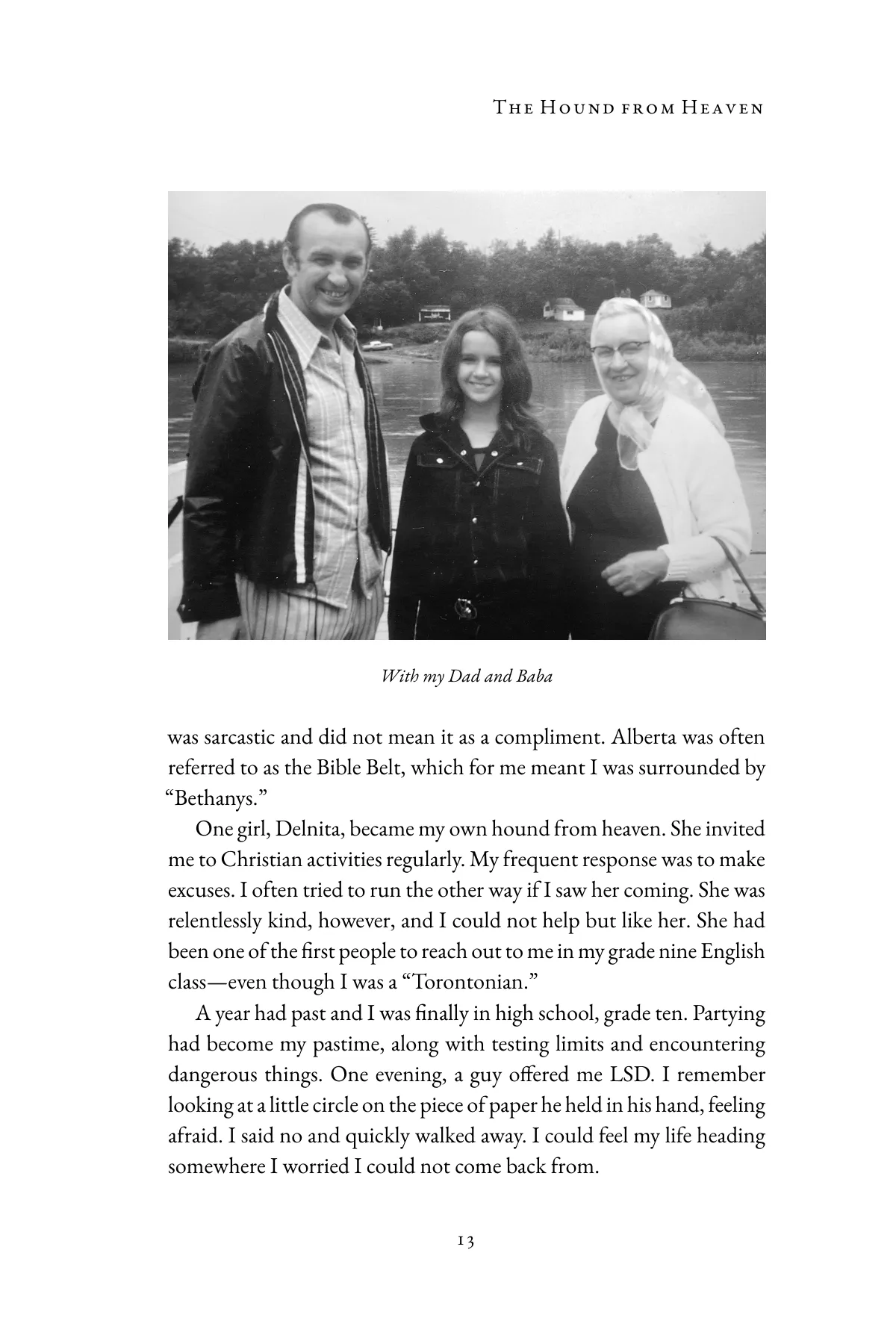
was sarcastic and did not mean it as a compliment. Alberta was often referred to as the Bible Belt, which for me meant I was surrounded by “Bethanys.” One girl, Delnita, became my own hound from heaven. She invited me to Christian activities regularly. My frequent response was to make excuses. I often tried to run the other way if I saw her coming. She was relentlessly kind, however, and I could not help but like her. She had been one of the first people to reach out to me in my grade nine English class—even though I was a “Torontonian.” A year had past and I was finally in high school, grade ten. Partying had become my pastime, along with testing limits and encountering dangerous things. One evening, a guy offered me LSD. I remember looking at a little circle on the piece of paper he held in his hand, feeling afraid. I said no and quickly walked away. I could feel my life heading somewhere I worried I could not come back from. [Photograph on this page, captioned: With my Dad and Baba.]
By grade eleven, just one month before Christmas, my world was imploding. Some of it was typical teenage pain—a disagreement with a friend, a broken relationship. But underneath was a deeper dissatisfaction, all of it wrapped in the same restlessness and aching I had carried since Toronto. Walking out the main doors of my school, I headed to the large parking area where school buses congregated in a maze. Mine was always parked in a specific row. Delnita came around the corner—there was no time to hide or walk in another direction. She had found me. She laid out a plan for my weekend. This time I gave in. It was a Friday. I had no other plans. Together we traveled to a weekend youth retreat hosted at a Christian Bible camp. There was a lot of snow, and the lake was solid ice. Our group of about twenty took over one wing of the large facility. It was a different kind of time—no drugs, no drinking, no swearing, but a lot of laughing and clean fun. They included me and asked for nothing back. At one point I slipped away to the girls’ dorm room. I needed something from my suitcase under the bed and knelt down to reach for it. A girl came in and stopped in the doorway. I glanced up. From the look on her face, I think she thought I was praying—and before I could say otherwise, she was gone. Oh no, I thought. By the time I reached the bottom of the stairs, I could see the same look on other faces—the assumption had already made its way around the room. The large room had a fire burning in the stone fireplace, and the group was gathering around it. Several young people came toward me with big grins, welcoming me as though something had been decided. “Cathy, I am so happy—welcome to the family of God!” I was shocked. I had not made any decision. But standing there, caught
off guard and stunned by their welcome, I was afraid. I remember quietly saying under my breath: God, they think you have come into my life. So if you are real, come in. I meant it, sort of. Later that evening our group crowded around the fire for a singalong. I mostly listened. These songs were all new to me, but they were full of meaning. However, by the following weekend, the pull to hang out with my old friends had taken over. Now in a different living room—music playing from somewhere, a drummer’s beat making its way to the wall I was leaning on—I looked around at the brownness of it all. The furniture, the mood, everything the same dull shade. Around me, my old friends were doing what they always did on weekends—some drowning out whatever they were carrying with a drink in one hand or a joint, others chasing the edge of something harder. I had done it all before. I was tired. I was tired of drowning. I made a decision in that moment to quietly leave. I wanted to go home and be on my own to think. I remembered the confidence of Bethany and Delnita—they were certain of what they believed. Hoping it was true, that there was a God who would hear my words, I prayed meaning it: God, if you are real like those Christian kids say you are, please save me, change me. My friend group changed first. Then, slowly, so did I. Learning that God had sent His Son to die for me was staggering. I had a lot of patterns and bad habits that needed changing. But during this time a realization came. God was there. He had rescued me. He had adopted me. I was His.
Delnita later told me that a group of teenagers and young adults had been praying for me long before I ever thought to pray for myself. They had been asking God to draw me. He had been listening. Someone had cared enough to bring my name to God when I did not even know His. In that season, Bill Gaither’s song Something Beautiful became my theme song. It spoke of brokenness and confusion offered up to God, and something beautiful made in return—the redemption of a messed-up, struggling life. Mine. I sang it under my breath, at home, and in the hallways at school. I still sing it today. The Bible became an anchor. I could see that it held the answers to my questions, and I grew to love reading it. Romans 6:23 says, “For the wages of sin is death, but the gift of God is eternal life in Christ Jesus our Lord.” Learning what Jesus did, understanding that He died to pay my sin debt and give me a new life in Him, changed everything. I received this free gift. I had done nothing to deserve it—but it was exactly what I desperately needed. It was now grade twelve, my last year of high school. One morning, it dawned on me that I had not cried the day before. Or the day before that. The knot in my stomach had been gone for a while. The heart of stone the Bible talked about—mine for so long—had really been exchanged for a heart of flesh. I discovered the power of forgiveness. I was forgiven, and learning that forgiving others would free me, especially from bitterness. Restitution was also a new concept. I thought about my shoplifting days. Sitting down with my checkbook, I added up my totals and sent a letter of apology and a check to each store. A heavy burden, now gone. The confused, hurting girl who struggled with anger, stealing, daily tears, and had thrown an ashtray at her own father graduated high school that year as someone new. For the first time in years, what I felt most, was a hope-filled happiness—new friends, a new direction, and the quiet relief of no longer being so confused about who I was. My
desire was to live for someone other than myself. I was slowly learning that He would keep me, and that I could trust Him.
CHAPTER THREE The Jeweler’s Mistake Eighty dollars. That was all it cost to meet my husband. It was on a ski trip to Jasper, Alberta, and eighty dollars covered everything—transportation, accommodation, hot cooked meals, and your lift ticket for a full week in the Canadian Rockies. Some lovely older ladies from the church came along and did the cooking. One of the girls from the group decided to invite a friend she knew from high school. The friend had no interest in skiing and passed the phone to her brother, Greg, who loved to ski. “Sign me up!” he said, as soon as he heard everything included in the price, and then he called two buddies to see if they wanted to join him. Greg had no interest in the faith part. He just loved the deal. I had seen him before in high school—he was in grade twelve when I was in grade ten. Tall and blonde, with blue eyes and an easy smile. Handsome without being showy about it. He was also a gentleman, which set him apart. We talked off and on during the trip, but dating a non-Christian
was out of the question for me. He was a nice guy. I was not interested in him as anything more than that. On one of the evenings while in Jasper, Greg went to a bar with his two buddies—his partners in crime, who had come for the eighty-dollar deal. Greg told me later what happened. He was sitting in the back of the bar, the music thudding, the air thick with smoke, sipping a beer, watching people dance and drink. One question came to his mind. Is this what I am going to be doing for fun when I am forty? This is not fun anymore, and I don’t like who I am becoming. He left the bar and walked back to the house where we were staying. Everyone was playing board games and hanging out. We had also been praying for those three guys, so seeing Greg come back early made us curious. He joined in, played games, and got into several conversations about faith. Later in the evening he took a gospel tract to his room, climbed up onto his top bunk, and read it. He read the prayer part again and again until he had it memorized. He believed praying with your eyes open might not be effective—so he closed them, and carefully prayed, confessing he was a sinner and asking God to save him. The next morning the sky seemed bluer to him, the sun brighter. He felt brand new. At breakfast he picked up a muffin and a juice and asked, in his fresh innocence, “Should I thank God for this?” Those of us around him saw the spark of a new life. Later that day, riding up the chairlift with a stranger, Greg launched into the love of God and the hope of knowing Him. The stranger was trapped—and when they reached the top, he skied away fast. Greg did not mind. He had new joy and did not care who knew about it. Back home, Greg started attending a Bible study at a place we all called the “guys’ house”—where five Christian guys lived together in town. Running into him there became a regular thing. There was an attraction now, but we were both cautious. He was not sure what I thought of him, and I was not sure what he thought of me. Without
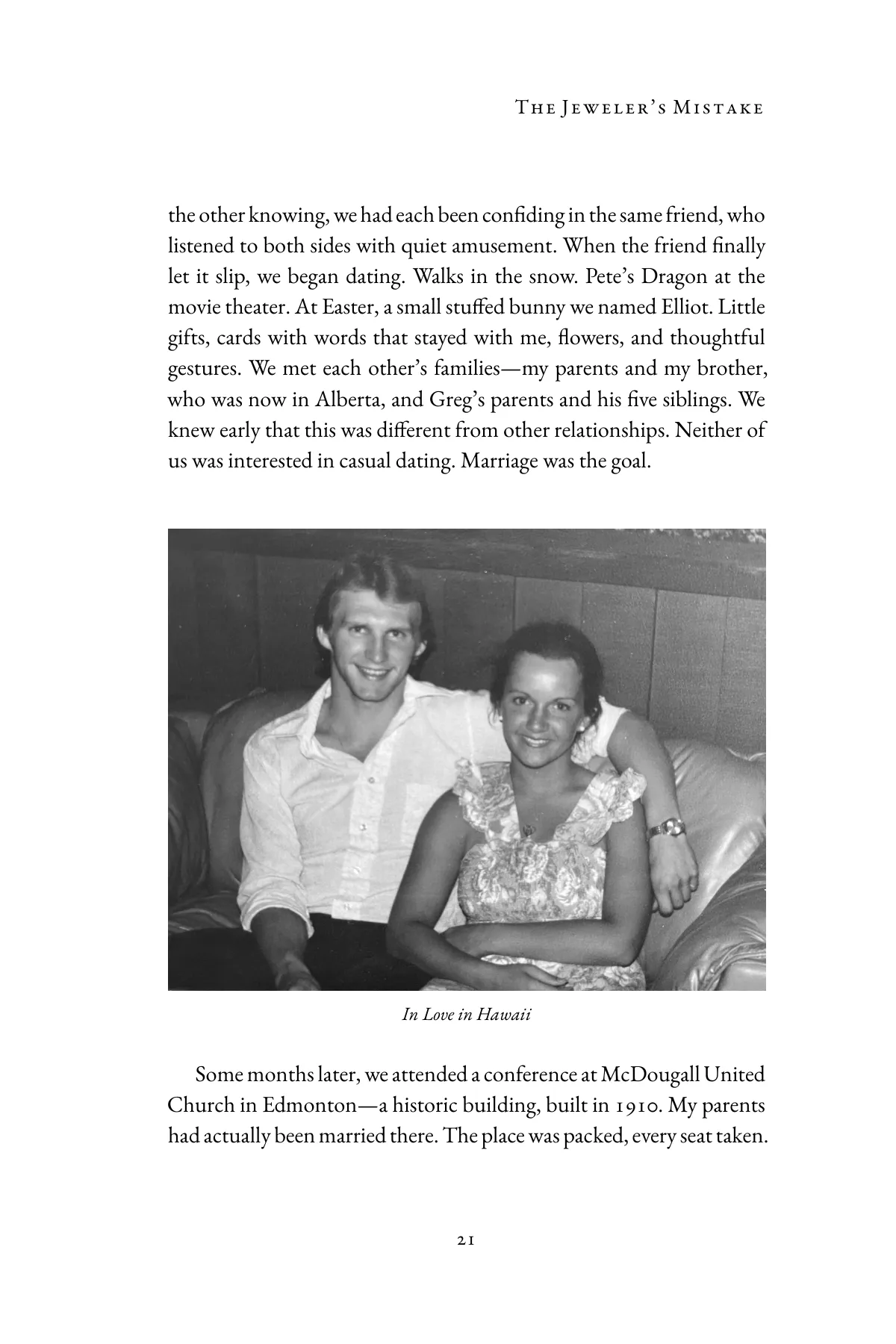
the other knowing, we had each been confiding in the same friend, who listened to both sides with quiet amusement. When the friend finally let it slip, we began dating. Walks in the snow. Pete’s Dragon at the movie theater. At Easter, a small stuffed bunny we named Elliot. Little gifts, cards with words that stayed with me, flowers, and thoughtful gestures. We met each other’s families—my parents and my brother, who was now in Alberta, and Greg’s parents and his five siblings. We knew early that this was different from other relationships. Neither of us was interested in casual dating. Marriage was the goal. Some months later, we attended a conference at McDougall United Church in Edmonton—a historic building, built in 1910. My parents had actually been married there. The place was packed, every seat taken. [Photograph on this page, captioned: In Love in Hawaii.]
Brother Andrew was speaking. He was a Dutch missionary known as “God’s Smuggler”—famous for smuggling Bibles behind the Iron Curtain during the Cold War. Both of us were on the edge of our seats when he called out to the audience, something to this effect: “As Christians, God has asked us to lay down our lives for Him. If He called you to a country closed to Christianity—a country hostile to Christians, a country where you could be arrested for sharing the gospel, or killed—would you go? If so, please stand.” Greg rose immediately, without hesitation. Fearfully but willingly, I followed. That summer, after hearing Brother Andrew, we both decided to attend a Christian missions training program available in locations around the world. We chose different places, recognizing the separation would either end our relationship or cement it. This was the late 1970s. I applied to several locations, deciding I would go to whichever responded first. Hawaii was first. Not at all a sun and surf kind of girl, I packed my bags and went anyway. I left home; this would be my first time being on my own. In Hawaii I had nine girls for roommates. Greg left one week later for the same program in Oregon. There was no email, so Greg and I wrote letters to each other every week. We still have a large box holding all those letters. We sent each other parcels too. I baked him homemade fudge and cookies. He sent me a beautiful necklace, and once a brand-new Bible laced with American money tucked between the pages. We were both growing in our faith, and around the same time, we both felt we should set our relationship aside for a season and focus on what God was teaching us. The pause was not long, but it was good for us both. Greg flew to Hawaii on his Christmas break to visit me at my school. The staff had given him special permission, as boyfriends were typically not allowed to visit. We rented mopeds, played mini golf, enjoyed a sunset dinner, and walk along the beach. We also had a
chaperone for the five days—a fellow student had been given the job. While we enjoyed the ocean, the chaperone discovered coconuts, gathering them and making coconut chips in the school kitchen every evening. We learned to love coconut chips, lightly salted and delicious. During those five days, we enjoyed some more serious conversations and counsel from an older couple. When Greg left to return to Oregon, we were both resolute in our devotion to God and His ways, eager to live that out together. After the year was finished, we got engaged. With little money for rings, we went to pawn shops. We had already tried regular jewelry stores, but they were too expensive. In a rough part of the city, past barred windows and hand-painted signs, we walked into a small shop that smelled of dust and old things. Several sets of wedding bands sat under the glass, but one matching set caught our eye right away—white and yellow gold, exactly what we wanted. Ninety dollars. They fit perfectly without sizing. We were thrilled, but we tried not to look it. Stepping outside for a minute, we rounded the corner and squealed like little kids. Then Greg walked back in with his negotiating face on. “Will you take eighty?” The owner thought about it, then said, “How about I shine them up for you, and you pay me eighty-five?” It was a deal. They were ours. Eighty-five dollars for the pair. We still wear them today. A couple of days before the wedding, Greg said, “Come with me—I have something for you.” We drove to a jewelry store, and he came out carrying a pretty box. Inside was a delicate silver bracelet watch, his wedding gift to me. He said, “Cathy, turn it over and look up the inscription.” I found my Bible and looked up the reference he had engraved on the back. I read it out loud: “Ephesians 5:21—Submit to one another out of reverence for Christ.” Greg looked surprised. “No,
that is not the verse.” He took the watch and checked. “Oh no, they engraved the wrong bible verse! It is supposed to say Ephesians 5:31—For this reason a man will leave his father and mother and be united to his wife, and the two will become one flesh.” We would come to learn that the engraver’s mistake was no mistake at all. Submitting to one another out of reverence for Christ would become one of the biggest challenges of our marriage. It would involve dying to ourselves—our rights, our preferences—over and over, choosing to serve and prefer each other. The jeweler got the numbers wrong. God got them right.
Keep reading

The story is just beginning

These pages are the foreword by Ray Comfort, the introduction and the first three chapters of Saving Hosanna, exactly as they appear in the printed book. The road to China, and to Hosanna, is still ahead. Read the rest of the story in paperback or on Kindle.